Patina is the surface record of an object's life: the gradual change that light, air, handling, and time leave on a watch dial or a wooden armrest. For collectors of both vintage timepieces and design furniture, that record is not a flaw to be corrected but a credential to be read. The distinction that matters — and the one this article will teach you to make — is between aging that is even, consistent, and structurally harmless, which tends to signal originality and support value, and aging that is localized, abrupt, or artificial, which signals damage or manipulation and works against both. The same diagnostic logic applies whether you are turning a tropical-dial dive watch in your hands or running a palm along a mid-century chair.
What is Patina? A Collector's Definition
Writing on vintage furniture, Retros Gallery frames the concept in a way that transfers cleanly to watches: "Patina preserves form while enriching surface. Damage interrupts form altogether." A chair whose armrests are gently polished by decades of hands tells a different story than one weakened by poor storage. Design, in this view, does not end when an object leaves the workshop; time becomes an additional layer, invisible at first and gradually expressive. Wood fibers respond to light and develop tonal variation; leather becomes more supple, shaped by posture and movement.
Old Plank, an antique furniture dealer, describes the same process in practical terms: authentic patina usually follows patterns that align with how a piece is used. Areas that receive frequent contact — drawer pulls, armrests, table edges — may appear slightly smoother or darker, and these changes develop gradually through handling. Crucially, the wood, finish, and hardware often age together, creating a balanced appearance across the entire piece.
Watch specialists use nearly identical language. A collector's guide from Vintage Watch Services describes a warm ivory dial, faded bezel, or softly browned lume as details that connect a watch to decades of wear, storage, sunlight, and careful ownership — while cautioning that patina is one of the easiest areas to misunderstand when buying vintage. The common thread across both categories: patina is gradual, use-shaped, and surface-level. It enriches without compromising structure. Damage, by contrast, is what neglect or mistreatment leaves behind.
The Art of Aging: Desirable Patina in Watches and Furniture
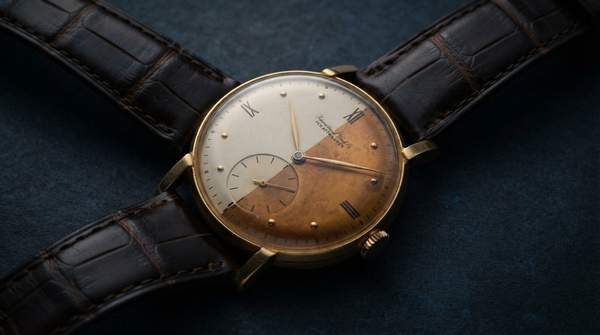
On watches, the desirable forms of aging have names that collectors actively seek. Noah Mackie, writing for Noah's Fine Watches & Jewelry, gives the canonical examples: a ghost bezel that fades uniformly, a tropical dial that shifts color across the whole surface, and lume that reads the same on every index. These are not defects but evidence — of decades of light exposure, of honest ownership, of a dial that has never been swapped or refinished. A faded bezel on a dive watch or a warm ivory dial can make a vintage piece feel, in the Vintage Watch Services guide's phrase, "genuinely alive."
Furniture patina is quieter but follows the same logic. The high-contact zones — the armrest polished by decades of hands, the drawer pull darkened by fingertips, the table edge worn smooth — carry the object's history of use. Old Plank notes that these subtle details are exactly what help collectors identify real antique patina rather than recently altered surfaces. The value in both categories comes from the same place: the aging is legible as the trace of a real life, not as an accident or an effect.
That desirability has a market dimension. Christie's, discussing the patina trend in watches, quotes a collector who wanted "a watch that has been made unique by the ageing process" — and observes that well-known models such as the Rolex Submariner and Omega Speedmaster are especially rarely found in original condition, precisely because their fame has encouraged decades of servicing and restoration. Scarcity of honest, unaltered surfaces is part of what makes them prized.
Damage vs. Patina: A Diagnostic Framework
The foundational skill, as Mackie puts it, is "learning to separate what time did naturally from what happened because a watch was mistreated." The checklist below organizes that skill into four diagnostic dimensions — consistency, location of wear, surface integrity, and component matching — each of which can be applied to a watch or a piece of furniture during a visual inspection.
Patina Assessment Checklist for Collectors
Work through the four questions in order. Each answer classifies the aging you are seeing as likely authentic patina, likely damage, or a possible artificial treatment.
| Dimension | Diagnostic question | Points toward authentic patina | Points toward damage or artificial aging |
|---|---|---|---|
| Consistency | Is the aging even across the surface? | A ghost bezel fades uniformly; a tropical dial shifts across the whole surface; matching lume reads the same on every index; wood, finish, and hardware age together in balance. | Artificial aging often looks uniform or abrupt; chemically forced effects lack organic development. |
| Location of wear | Does the wear appear where the item is actually touched? | Drawer pulls, armrests, and table edges appear slightly smoother or darker from frequent contact. | Wear in places hands and use would never reach suggests distressing done for effect. |
| Surface integrity | Does the aging enrich the surface or interrupt it? | Patina preserves form while enriching surface; the piece remains structurally sound. | Moisture intrusion leaves rings or spotting; radium degradation pits the dial around the indices; mold blotches; deep scratches and water stains interrupt form. |
| Component matching | Do all components show the same era of aging? | Original dial, original hands, original case — each aging in a coherent way. | Mismatched aging across components suggests replacement or restoration. |
Two cautions sharpen the framework. First, artificial aging exists in both worlds: Old Plank notes that many modern furniture pieces are intentionally distressed to mimic antiques, and the watch guide from Wristler, written by Timo Klinge, documents the practice of placing dials in direct sunlight at high altitude to force warm discoloration, or treating aluminum bezels with bleach to create a prematurely faded effect. Second, patina alone is not proof of anything: Luxury Time NYC advises treating patina as one detail, not proof of provenance, and assessing originality by considering the watch's components and available records together, with authentication where needed.
Preserving History: Patina, Originality, and the Risks of Restoration
The reason collectors prize patina at all is originality. Mackie is blunt about the relationship: "Patina only carries value if it's authentic and authentic patina only exists on original components. Original dial. Original hands. Original case." Fully correct pieces — those with all their original parts aging coherently — command the market's highest prices. The Vintage Watch Services guide makes the same point from the buyer's side: for collectors, patina is rarely about chasing imperfection for its own sake; it is about originality.
This is where servicing becomes a genuine risk rather than routine maintenance. Mackie's advice is that the right call is often to leave a vintage watch alone: a movement that runs accurately doesn't need to be opened, and a case that shows honest wear doesn't need to be touched. A single careless service appointment — incorrect lubricants, replaced movement components, or a polished case — can quietly erase much of what made the piece valuable. Luxury Time NYC explains the mechanics of that loss: attempts to strip discoloration or restore a dial's former color can damage printing, finish, or luminous material, and case polishing removes metal and softens original contours. Patina, in other words, is not reliably reversible; cleaning may remove surface dirt, but the aged character underneath generally cannot be recovered once removed.
The same principle governs furniture. A piece whose finish has been stripped and renewed may look fresher, but it has lost the balanced, use-shaped surface that told its story — and, as Retros Gallery argues, value in vintage furniture is tied not to visual perfection but to authenticity and integrity. Restoration that replaces original finishes or components does to a chair what a polished case does to a watch: it resets the object's most convincing evidence of age.
Making Informed Decisions: Patina as a Mark of Authenticity
Collectors should prioritize vintage watches and furniture that exhibit consistent, natural patina over heavily restored pieces or those showing signs of damage, because authentic patina is a strong indicator of originality and often enhances value. This is a guide for visual assessment, not a substitute for professional authentication, and it concerns principles of value rather than specific monetary figures.
The measurable indicator to apply at inspection: the presence of even, consistent aging patterns in expected high-contact areas, coupled with original components, indicates desirable patina; conversely, localized damage such as moisture spotting or pitting, inconsistent aging across components, or signs of replaced parts signal caution. Run the four checklist dimensions — consistency, location, surface integrity, component matching — on any candidate piece before committing, and treat a pass on all four as the threshold for pursuing a purchase further, with independent authentication where provenance matters.
Sources
- Why Patina Is Not Damage: Learning to Value Time in Design — Retros Gallery
- Understanding Patina and Why Age Adds Character to Antique Furniture — Old Plank
- Musings - Vintage Watch Services — Vintagewatchservices
- Patina & Originality in Vintage Watches — Noah's Fine Watches & Jewelry
- The patina trend in watches — Christies
- What Is Patina on a Watch? Aging, Value & Collector Appeal — Wristler
- Vintage Watch Patina: What to Look For Before You Buy — Luxury Time NYC