Savile Row and Neapolitan tailoring are the two most distinct and well-documented schools of bespoke menswear, and the choice between them is not a contest of quality. As the custom tailor Amedeo Scarano frames it, "British tailoring constructs. Neapolitan tailoring accompanies." Savile Row builds a garment that holds a formal, commanding line with padded shoulders and a firm canvas; Naples builds one that moves with the body, with soft construction and a relaxed drape. Understanding the specific construction differences lets you match the style to your body, climate, and professional life.
The Enduring Legacies: Savile Row and Neapolitan Tailoring
British tailoring — with London's Savile Row as its emblem — set a widely recognized benchmark that shaped other traditions. Writing in the Gentleman's Gazette, Bernhard Roetzel cautions against the popular explanation that London's pronounced shoulders and waisted silhouette come simply from military tailoring, noting that "both assumptions are not correct because London tailors always offered very diverse silhouettes and Italy is home to very different styles too." The perceived primacy of British cuts was real, though: Permanent Style reports that tailors promising a British aesthetic thrived in the 19th century, including British-named Parisian houses founded in that era.
Neapolitan tailoring emerged later, in the early twentieth century, as a counterpoint to the structured British model. A style defined by lightweight construction, natural shoulders, and minimal padding, it reflected the climate, culture, and relaxed lifestyle of southern Italy rather than the formality of a London boardroom. The result is a tradition with its own coherence — not a softer imitation of Savile Row, but a different philosophy about how a man looks best. Parisian tailoring also exists as a third school, but its definition is less monolithic, and it is best treated as its own case rather than forced into this two-way comparison.
Savile Row: The Epitome of Structure and Formality
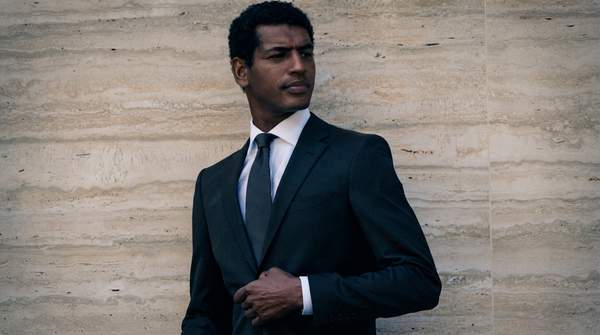
Savile Row's defining move is at the shoulder. The custom clothier H.M. Cole describes Savile Row shoulders as "structured, often padded or roped for a clean, commanding line." Roping refers to the pronounced ridge of fabric where the sleeve meets the shoulder, and the padding beneath it builds a strong, defined silhouette regardless of the wearer's natural frame. A sloped shoulder disappears beneath the construction; the jacket, not the body, sets the line.
That shoulder sits on an equally firm foundation. H.M. Cole characterizes Savile Row construction as a "more structured chest, stronger canvas, and a more formal internal build." The canvas is the layer of material between the outer cloth and the lining that gives a jacket its shape, and here it is robust, providing a stable architecture that holds its form over years of wear. Lapels run wider and more formal, contributing to the commanding presence the tradition is known for. The overall effect is a garment that projects authority — the reason this construction remains the default reference for formal and traditional professional settings.