A pair of true bespoke shoes is made twice. According to the workshop Canons, which follows traditional English hand-welted shoemaking, every new bespoke last triggers the production of a separate pair of trial fitting shoes in the chosen leathers. Only after that fitting, and after the lasts and patterns have been adjusted, is the final pair cut and made afresh. The full journey typically spans six to twelve months.
Understanding that sequence is the key to appreciating what a bespoke client is actually buying: not a shoe chosen from a shelf, but a wooden form carved to the exact shape of one person's feet, around which an entire pair is constructed by hand. Here is how artisans describe the process, stage by stage.
The Bespoke Shoemaking Journey: An Overview
Bespoke shoemaking is the original form of the craft, not a modern luxury offshoot. Maida's Bespoke Footwear notes that the trade dates to the 1600s and that industrial mass production grew out of bespoke methods, "not the other way around." The workshop also makes a striking claim about scarcity: fewer than fifty true bespoke shoemakers exist on the planet.
The process is collaborative and sequential. Each stage builds on the one before it: measurements inform the last, the last informs the patterns, the patterns inform the trial shoes, and the fitting informs the final pair. Skipping or rushing a stage compromises everything downstream, which is why the timeline stretches across many months rather than weeks.
What follows focuses on traditional hand-welted leather footwear. It describes the general craft rather than any single maker's commissioning procedure, and it deliberately omits pricing, which varies widely between artisans and regions.
Step 1: Consultation and Precise Foot Measurements
Everything begins with data gathering. Italian Shoe Factory describes a measurement process followed by pictures and scans of the foot, taken so the maker can refer back to intricate details when creating the shoe lasts. The foot is not treated as a set of lengths alone; the consultation captures its curves, anomalies, and the way it rolls during walking.
That last point matters more than it might seem. The same artisan account explains that how a foot rolls when one walks affects factors such as heel height. A measurement session, in other words, is as much a study of movement as of static shape.
The client also selects a style at this point. The design conversation and the anatomical data proceed together, because the chosen style constrains what the last must achieve in toe shape and heel height.
Step 2: Crafting the Bespoke Last
The industry has an old adage, quoted by Maida's: "the last shall come first," meaning each last model must be developed before design, patterns, and production can take place. A last is a mould that emulates a foot to give the shoe its shape, carved from wood or plastic, with one needed for each left and right shoe. Every last model determines the toe shape, heel height, and, most importantly, the fit.
A true bespoke last is carved from the individual client's measurements and scans. Maida's distinguishes this from two lesser methods. A custom shop last—technically "made-to-measure"—selects a symmetrical pair of mass-production lasts from an in-house inventory that merely approximates the client's measurements. Mass-production lasts, meanwhile, serve entire size runs, not individuals.
The last also stays in use throughout construction. Italian Shoe Factory explains that the last is placed inside the shoe so it can be modelled around it, then used again near completion to verify that the end fit matches the original design.
Step 3: Pattern Cutting and Material Selection
With the finished last in hand, a designer or cutter makes a paper pattern for the chosen style. The pattern consists of individually named pieces: vamp, cap, tongue, and quarters. Translating a three-dimensional last into flat two-dimensional pieces that will reassemble seamlessly around it is one of the craft's most demanding skills.
Writing for Bondeno, Charles Kelso frames pattern making as the hallmark of the bespoke tradition. He describes how the Industrial Revolution introduced mass-producing machinery, yet bespoke shoemaking persisted and preserved pattern making as a marker of quality and individuality. His account emphasizes that a deep understanding of both design and construction is required at every step.
Material selection runs alongside. The pattern cutter must understand how chosen leathers stretch, hold shape, and behave once stitched, since the accuracy of the initial patterns directly governs the fit and aesthetics of the finished shoe.
Step 4: Trial Shoe Creation and Fitting
Here bespoke departs most sharply from any ready-made or made-to-measure alternative. Canons explains that for each new bespoke last, a trial pair of fitting shoes is crafted from the chosen leathers for a client fitting. After this fitting, adjustments are made to the lasts and patterns. The trial shoes are then discarded, and the final pair is cut and made anew.
The fitting itself is forensic. Italian Shoe Factory recounts that while the client wears the trial shoe, the Master Last-Maker takes final measurements and makes incisions to check the shoe for even the slightest pressure on the foot. The client can request revisions at this stage, such as changes to heel height or the shape at the toe.
Every adjustment, however tiny, feeds back into the client's last. This is the mechanism by which a bespoke pair converges on a genuinely perfect fit: the intermediate shoe exists precisely so that errors can be found and corrected before the real leather is cut.
The Bespoke Shoemaking Timeline
The stages above interlock into a single chronological model, synthesized from the accounts of several practicing artisans. Read down the sequence to see how each stage's output becomes the next stage's input—and why the trial fitting sits at the process's heart.
| Stage | Purpose | Key activity | Outcome |
|---|---|---|---|
| 1. Consultation & measurement | Capture the foot's exact character | Measurements, pictures, and scans taken by the artisan, with attention to how the foot rolls when walking | Complete anatomical data plus a chosen style |
| 2. Last making | Create the shoe's foundation | Wooden or plastic mould carved as a precise replica of the client's foot | A unique left and right last to build around |
| 3. Pattern cutting | Translate the last into 2D pieces | Paper patterns for vamp, cap, tongue, and quarters, with leathers selected to suit | Precise patterns for the shoe's upper |
| 4. Trial shoe creation & fitting | Test fit before final construction | Separate trial pair made in the chosen leathers, worn by the client while the maker checks pressure points | Adjustments to lasts and patterns; trial pair discarded |
| 5. Final adjustments | Refine the foundation | Lasts and patterns revised per fitting findings, including heel height and toe shape | A corrected last ready for the final pair |
| 6. Final construction & finishing | Build the definitive pair | Hand-welted assembly: lasting, welt stitching, sole attachment, and finishing checks against the last | The finished bespoke shoes |
Two durations deserve emphasis. Maida's states the overall process typically takes six to twelve months, depending on design complexity and the number of fittings required. The same workshop also notes that bespoke makers are commonly booked two or more years out, so the wait before the process even begins can exceed the making itself.
Step 5: Final Construction and Finishing
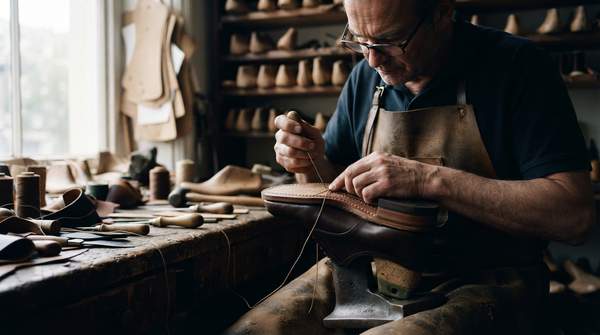
Only after the fitting cycle completes does the master craftsman receive the corrected lasts, adjusted patterns, and chosen leathers. Bondeno's account of construction describes the upper attached to the last, then the shoe built through a series of steps that may include lasting, welt stitching, and sole attachment—with the pattern maker's initial work guiding each step so the shoe retains its intended shape and fit.
Hand-welting, the method Canons identifies with traditional English shoemaking, is what allows this precision. The shoe is modelled around the last throughout assembly, and the last is consulted once more near completion to confirm the end fit matches the original design.
It is also what extends the shoe's life. Canons presents its hand-welted construction as the basis for repairable shoes: a shoe built around a last in this manner can be taken apart and rebuilt rather than discarded, a durability argument that pairs naturally with Bondeno's framing of pattern making as preserved artisanal quality.
Appreciating Bespoke Craftsmanship: A Decision for Connoisseurs
Clients considering bespoke footwear should recognize that it is a significant investment in time and craftsmanship, requiring patience and collaboration with the artisan. The decision is not merely a purchase of a six-to-twelve-month process; it is participation in one, involving measurement sessions, fittings, and design conversations in which the client's own feedback reshapes the lasts.
The measurable indicator of progress is concrete: the client's bespoke shoes advancing through the stages of last creation, trial fittings, and final construction. A buyer can track exactly where their commission sits, and expect a trial pair in the chosen leathers before the final pair is cut. When the last has been adjusted from the fitting's findings and the finished shoes match the last's design, the process has done what only it can—produced a pair shaped to one pair of feet alone.
Sources
- How We Make Our Bespoke Shoes — Canons
- What is Bespoke? - Maida's Bespoke Footwear — Maida's Bespoke Footwear - Bespoke Footwear By Master Craftsmen
- Shoemaking Process: How Shoes Are Made — Italian Shoe Factory
- The Art of Pattern Making in Bespoke Shoemaking — Bondeno