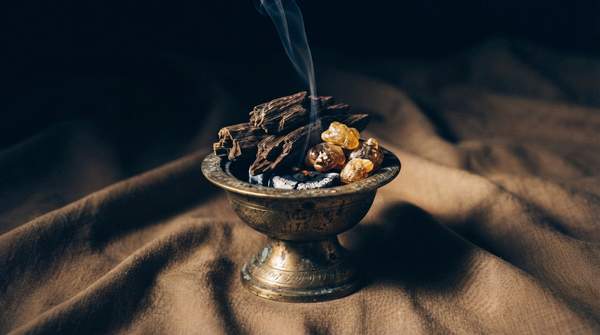
Long before a fragrance lingers on skin for hours, that persistence is engineered in the formula—and two ingredients do this work in strikingly different ways. Oud is a natural resin born of an infected tree; ambroxan is a synthetic molecule designed to imitate the scent of ambergris. One contributes depth and opulence, the other radiance and endurance. Understanding which is at work in a fragrance explains both how it smells and how long it will last.
The Art of Fragrance Longevity: Oud vs. Ambroxan
Longevity is not an accident of concentration alone; it is built into the choice of materials. The finest perfumes are structured in layers, with lighter opening notes fading first and heavier materials persisting longest on the skin. Within that structure, certain ingredients carry a disproportionate share of the staying power: dense natural resins on one hand, and modern synthetic molecules engineered to hold an entire composition together on the other.
Oud and ambroxan sit at opposite ends of this spectrum—one ancient, rare and natural, the other contemporary, replicable and synthetic—yet both are prized precisely because of what they contribute to a fragrance's endurance and character. Comparing them directly reveals why perfumers reach for each in such different situations, and why a connoisseur reading a note list can predict a scent's behavior from these two names alone.
Oud: The Natural Depth of Agarwood
Oud begins with the aquilaria tree, which grows primarily in Southeast Asia, including India, Cambodia, and Indonesia. When the tree is infected with a certain type of mold, it produces a dark, aromatic resin to defend itself. That resin is harvested and transformed into oud through what Ilias Moussaoui, writing for Elegance Emiratie, describes as "a long and meticulous process." The material's very existence depends on a tree's response to disease.
The result is anything but simple. Oud's notes are intense and deep, offering a woody, smoky, resinous and slightly sweet scent, and its olfactory complexity is described as unmatched, with layers of nuance that evolve over time. That evolution is part of its appeal: a fragrance built around oud does not sit still, but shifts through its facets as hours pass.
Scarcity shapes both its price and its mystique. Cabernet Candles notes that oud commands prices often exceeding $1,000 per kilogram owing to its limited supply, and that its deep, woody aroma makes it a favorite of many perfumers. In perfumery, it is highly prized in oriental and woody compositions, used for the depth and richness it brings rather than for any structural support it lends to other notes.
Ambroxan: The Modern Synthetic Fixative
Ambroxan is an entirely different creature: a synthetic aroma molecule that smells clean, warm, woody and slightly mineral, like skin. Perfumers use it to add radiance, volume and staying power to a fragrance. Dr. Nadeem Crowe, writing for Rook Perfumes, is precise about its origins: it is made from clary sage or by fermentation of sugar cane, and although it was developed to reproduce the main odour of ambergris, it is neither amber nor ambergris itself.
Fragrantica's ingredient profile groups ambroxan among musky, amber and animalic smells, describing it as a modern synthetic compound with a dry amber musky odor, sweet, woody and musky in character. Jomashop's fragrance guide adds that it was originally derived from ambergris, is today produced sustainably, and is valued for its versatility—blending seamlessly with citrus, marine, floral and woody accords, and enhancing a perfume's staying power wherever it appears.
What distinguishes ambroxan from oud is that it works quietly. Rawaromachem's fixative guide characterizes it as the most prized fixative in modern perfumery, warm, woody, skin-like and ambery, typically used at 1 to 5 percent of the concentrate. At 1 to 2 percent, it functions invisibly: present in the structure, felt in the wear, but rarely announcing itself the way a resin does.
Comparing Oud and Ambroxan: Origins, Scents, and Staying Power
Placing the two side by side reveals their fundamental differences at a glance—differences of origin, of scent, and of the kind of longevity each provides.
Oud vs. Ambroxan: A Comparative Overview
Use this table as a quick reference when reading a fragrance's note list: each row contrasts a defining attribute, from where the material comes from to how it behaves in the wear.
| Attribute | Oud | Ambroxan |
|---|---|---|
| Origin | Natural resin from the aquilaria tree, produced when the tree is infected by a mold; grown across Southeast Asia including India, Cambodia and Indonesia | Synthetic aroma molecule, made from clary sage or by sugar-cane fermentation |
| Source background | Harvested and processed through a long, meticulous process; can exceed $1,000 per kilogram owing to limited supply | Developed to reproduce the main odour of natural ambergris, a rare and expensive material; now produced sustainably |
| Scent profile | Intense and deep: woody, smoky, resinous and slightly sweet, with layers of nuance that evolve over time | Clean, warm, woody and slightly mineral, like skin; dry amber-musky with sweetness |
| Role in longevity | A heavy, rich material used in oriental and woody perfumes for its depth and richness | A fixative that slows evaporation, amplifies surrounding molecules, and adds staying power, volume and radiance |
| Typical use | A featured note carrying a fragrance's character | Structural support at 1 to 5 percent of the concentrate, invisible at 1 to 2 percent |
The pattern the table exposes is straightforward: oud is a destination ingredient, ambroxan a support ingredient. One is chosen for its own complex, evolving profile; the other is chosen for what it does to everything else in the formula.
The Role of Base Notes and Fixatives in Perfume Longevity
The two ingredients arrive at persistence through different routes, and the distinction matters. Oud's density and richness place it among the heavy materials that anchor a composition; ambroxan works as a fixative. A heavy base note contributes its own dominant character to the dry-down, while a fixative acts on the materials around it—slowing their escape, extending their presence, smoothing their transitions.
Ambroxan does more than slow evaporation, according to Rawaromachem's guide: it amplifies surrounding molecules and creates a deeply personal, skin-close quality that makes a perfume feel as though it belongs to the wearer. The same guide describes it as a structural blender, smoothing transitions between top, heart and base notes so a composition feels cohesive throughout its wear—extending not just the duration of a scent but the integrity of its development.
Oud, by contrast, persists through sheer material weight. Its resinous, smoky character unfolds in layers over time, which means its contribution to longevity is inseparable from its contribution to character: the fragrance lasts because the oud itself does, and what you smell in the later hours is largely the oud's own evolution. Ambroxan's longevity is relational; oud's is intrinsic.
Making an Informed Choice: Oud or Ambroxan?
For the connoisseur, the practical question is what kind of wear you want. If you seek a fragrance that announces itself, evolves dramatically and carries the aura of a rare natural material, oud-centered compositions deliver exactly that—along with the smoky, resinous depth that defines the oriental and woody families. If you prefer a scent that sits closer to the skin, lasting quietly and enriching its own top and heart notes as the hours pass, ambroxan-rich formulas are built for that effect.
The two can also appear in the same fragrance, doing complementary work: oud as the character of the base, ambroxan as the fixative holding the structure together. Recognizing both on a note list lets you predict a perfume's behavior before you wear it—whether it will be a statement or a whisper, and how it will change across the day.
Choosing Your Signature Scent: Understanding Base Notes
When selecting a fragrance, consider whether you prefer the deep, natural complexity and traditional longevity of ingredients like oud, or the clean, amplifying, and modern fixative qualities of synthetics like ambroxan, as these choices significantly impact the perfume's character and wear time.
The measurable test is the perceived longevity and evolving scent profile of a fragrance on the skin over several hours. Sample a formula, note which of the two materials is doing the work, and observe how it behaves across that window: an oud-led scent should reveal shifting layers of smoke, resin and sweetness, while an ambroxan-supported one should hold its structure smoothly and close to the skin. Either outcome confirms the ingredient's role—and either can define a signature worth keeping.
Sources
- Rare and exotic ingredients in perfumery: Focus on little-known olfact — Elegance Emiratie
- The Exotic Ingredients that Make Perfume a Captivating Mystery — Cabernet Candles
- Ambroxan in Perfume: What It Is and How It Smells — Rook Perfumes
- Ambroxan perfume ingredient, Ambroxan fragrance and essential oils — Fragrantica
- The Parlor - Blog by Jomashop
- What Is a Perfume Fixative and How Does It Work? — Rawaromachem