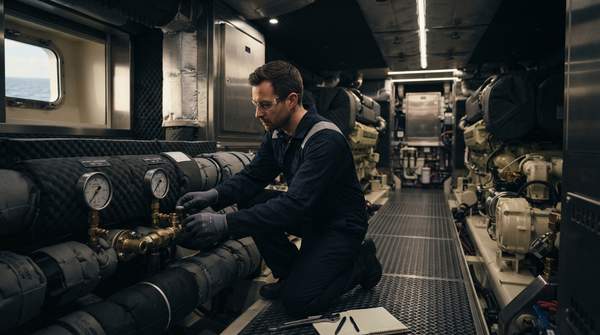
When a yacht feels genuinely quiet and evenly cool, that serenity is rarely an accident of materials. According to Moonen Yachts, which treats low noise and vibration as measurable engineering outcomes, the decisive distinction is between quiet engineering—controlling noise at its source from the first design stage—and soundproofing, which limits sound only after equipment has already created it. The same logic applies to climate: thermal insulation in the hull, deck, and bulkheads sets the baseline for what any air-conditioning system can achieve. Understanding these two distinctions changes what a buyer should ask before signing a commission.
Quiet Engineering vs. Soundproofing: A Fundamental Distinction
Moonen describes the difference as structural. Quiet engineering involves initial design choices that are hard to alter post-launch. These include hull material, machinery selection, equipment mounting, pipe routing, extraction airflow, and interior isolation, all of which impact the onboard sensory experience. Soundproofing, by contrast, supports those decisions afterward—through insulation, acoustic panels, double glazing, layered carpets, and soft furnishings. One approach prevents noise from travelling; the other absorbs what remains.
This is not a hierarchy in which soundproofing is dismissed. Moonen is explicit that soundproofing remains important, but frames it as one part of a system rather than the system itself. A yacht that relies on acoustic finishes to mask vibration from poorly mounted machinery is solving a problem that engineering could have prevented. The comparison below shows how the two approaches differ across design and ownership dimensions.