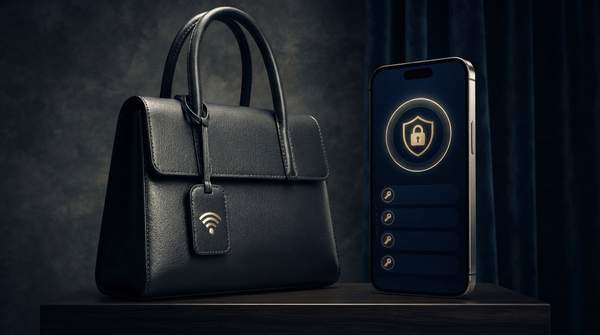
Luxury brands are fighting counterfeiting not with collectible tokens but with consortium blockchains—shared, private ledgers on which a product's journey is recorded step by step, creating a verifiable record that cannot be altered. The most prominent example is AURA, a non-profit consortium created by LVMH, Prada and Cartier-owner Richemont, which lets competing houses record product histories on common infrastructure. Understanding how this works requires seeing exactly when and where data enters the ledger.
The Challenge of Authenticity in Luxury Goods
The luxury goods industry, built on exclusivity and brand prestige, grapples with a pervasive counterfeiting problem that erodes both consumer trust and brand integrity, as Vaibhav Joshi notes in a 2025 literature review published in the International Journal of Engineering Research & Technology. A counterfeit handbag or watch does more than cost a brand a sale: it damages the credibility of every genuine product bearing the same name. Because counterfeit goods enter the market through opaque, fragmented supply chains, brands have historically struggled to prove where an authentic item came from, how it was made, and who has owned it.
This is where blockchain enters. Researchers Christoph Schmidt, Maximilian Klöckner and Stephan M. Wagner argue in a 2021 book chapter on supply chain traceability that blockchain enables product tracing along the supply chain, potentially ensuring product authenticity, provenance and ethical production. Counterfeits, they note, present a special challenge in luxury goods precisely because the value of the product is bound up in its history—and blockchain is a technology for recording history.
Blockchain Fundamentals for Supply Chain Transparency
At its core, a blockchain is a distributed database storing a ledger of transactions shared across participating parties. The network authenticates each transaction, and once a record is approved, it is cryptographically secured and stored—and can no longer be altered or deleted. This is what makes the ledger immutable and verified.
Three properties make this useful for luxury supply chains. Transparency means information is shared and verified without a third-party regulator. Integrity comes from cryptography and peer verification. Immutability means an approved transaction cannot be changed. Add decentralization—data stored across the network—and participants gain reliability and privacy while still sharing a common record. In a consortium setup, a group of brands jointly operates this network, so competitors share one version of the truth without surrendering proprietary data to any single party.
The Lifecycle of a Blockchain-Authenticated Luxury Good
The practical power of blockchain becomes clear when you trace a single item's journey. The model below sequences the supply chain stages that the evidence supports as blockchain recording points, showing how each step adds a transaction to the shared ledger. Over time, these cumulative entries form the item's "digital twin"—a tamper-proof history that proves authenticity and provenance. It is worth noting that this mechanism works only when all participating parties consistently record accurate data on the chain.
The journey, step by step
- Manufacturing and assembly. The product is registered on the blockchain as it is made, establishing its digital identity and linking it to verified production details. Each subsequent entry inherits the credibility of this first record.
- Distribution to the retailer. The item's movement through the supply chain is recorded as a transaction on the shared ledger, so every authorized handoff—warehouse, logistics partner, boutique—is verifiable and cannot be backdated or forged.
- Point of sale. When the product is sold, the transaction is written to the ledger, giving the consumer a record that ties their specific item to an authenticated distribution history.
- Post-sale ownership transfer. If the item is resold or gifted, its new ownership can be recorded, extending the digital twin beyond the boutique and into the resale market, where counterfeits often circulate.
Read together, these entries answer the question every luxury buyer silently asks: where has this object been, and can I trust the answer? Each stage is only as trustworthy as the data entered, but once entered, it is permanent.
Case Study: The AURA Blockchain Consortium
AURA shows what this looks like at industry scale. The consortium describes itself as a non-profit "created by luxury leaders to build shared trust, long-term value and strategic alignment across the industry," with members spanning fashion, watches and jewellery, beauty, leather goods, accessories, automotive, wine and spirits, home decor and diamonds. Its membership roster, published on the consortium's own site, positions it as a shared standard rather than any single group's tool.
Access is deliberately structured. According to reporting by Maghan McDowell in Vogue, brands must be approved by the board, then pay licensing fees plus a transaction fee per product; in return they can use Aura's private blockchain, a public blockchain, or a multi-blockchain approach. In 2022, the consortium launched Aura SaaS, which the Prada Group announced would lower up-front license and onboarding fees, let brands connect to the Aura blockchain directly through APIs into their own IT systems, and make the platform accessible to luxury brands globally. Joshi's review separately notes that LVMH leverages blockchain to provide traceable product histories, significantly reducing fraud, and that large brands such as LVMH and Burberry have demonstrated success with such implementations.
Key Benefits of Blockchain for Luxury Brands
The benefits cluster around two outcomes. The first is counterfeit prevention: by creating a verifiable, immutable record of a product's journey, blockchain gives brands a robust mechanism to safeguard authenticity and transparency—one that Joshi's review describes as collectively positioning blockchain as a superior alternative to traditional verification methods. A forged serial number can be replicated; a forged entry on a cryptographically secured shared ledger cannot.
The second is consumer trust. In a market increasingly driven by demands for transparency and ethical sourcing, an authenticated digital history lets a brand substantiate claims that once rested on reputation alone. Schmidt and colleagues frame traceability as also supporting ethical production claims, meaning the same ledger that proves a bag is genuine can also back assertions about how it was made. And because the record follows the product after purchase, it retains value in resale—an area where counterfeit risk is high.
Challenges and Considerations for Adoption
The hurdles are real and documented. Technical challenges include scalability, energy consumption and interoperability, with Deloitte noting that blockchain networks will require universal interoperability standards as the technology matures. Joshi's review adds that feasibility varies with organizational scale, technical infrastructure and industry-wide adoption, and that these challenges may hinder uptake particularly among smaller brands.
The consortium model introduces its own frictions. Joining Aura requires board approval, licensing fees and per-product transaction fees, and brands still face challenges in adopting digital product IDs across their operations, according to Vogue's reporting. McDowell also notes a regulatory driver: the EU's Ecodesign for Sustainable Products Regulation (ESPR) was expected to be published in the official journal with an implementation period potentially starting as early as 2026, after which brands would have 18 months to comply—deadlines that favor collective action. Finally, the whole mechanism depends on data quality at the point of entry: a blockchain guarantees that records cannot be changed, not that they were accurate to begin with.
Navigating the Future of Luxury Authenticity
Luxury brands should strategically evaluate consortium blockchain solutions like AURA to enhance supply chain transparency and combat counterfeiting, focusing on phased implementation and partner collaboration. The evidence suggests a clear logic: consortium platforms spread infrastructure costs across competitors, and the SaaS model has lowered the barrier to entry, making phased adoption feasible even for smaller houses. A brand need not authenticate its entire catalog at once—starting with high-counterfeit-risk product lines and expanding is the pattern the consortium's fee structure supports.
The measurable indicator to watch is increased adoption rates of private and consortium blockchain platforms by luxury brands, evidenced by new member announcements and reported product lines being tracked. With the ESPR's compliance window potentially opening as early as 2026 and giving brands 18 months to comply, digital product identity is shifting from a competitive differentiator to a shared industry requirement—and the brands that build the capability early will enter that window with the record already on the ledger.
Sources
- How the Aura Blockchain Consortium convinced luxury competitors to collaborate — Vogue
- The Role of Blockchain in Enhancing Transparency and Authenticity for Luxury Goods – IJERT
- Blockchain for Supply Chain Traceability: Case Examples for — IDEAS
- Members - Aura Consortium
- Aura Blockchain Consortium Launches Aura SaaS for Luxury Brands — PradaGroup
- Using Blockchain to Drive Supply Chain Transparency and Innovation — Deloitte