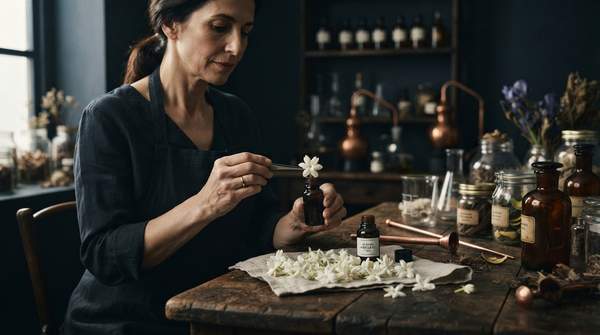
When a niche fragrance promises a rare botanical note, the price tag reflects a long, difficult journey rather than marketing alone. According to the luxury perfumer Goldfield & Banks, rare ingredients such as Boronia absolute can command $10,000 to more than $100,000 per kilogram, while common materials like Rose and Vanilla benefit from global cultivation and established supply chains that keep them affordable. The determining factors arrive in sequence: where a plant will only grow, how long it takes to mature, and how much essence a difficult extraction can actually recover.
Stage 1: Geographic Sourcing – Where Rarity Begins
Rarity starts with geography. The perfumery house Adar identifies geographic origin as a primary consideration in raw material selection, because climate and soil conditions directly shape an ingredient's quality. Some botanicals are endemic to a single region, meaning growers and perfumers must work within that territory's terrain, seasons, and political realities. An ingredient confined to one locality cannot simply be farmed wherever land is cheaper.
Goldfield & Banks contrasts this with Vanilla, which is sourced globally from Madagascar, Tahiti, and the Comoros. Widely distributed plants have diversified, resilient supply chains; endemic plants have a single point of failure. Adar adds a further layer: seasonal variations influence an ingredient's characteristics, so even within one region, harvest timing and environmental factors shift what a perfumer receives year to year.
Stage 2: Cultivation & Harvest – The Time and Labor Investment
Time is the second cost driver. Goldfield & Banks notes that rare ingredients typically have harvest windows of only two to four weeks, while common ingredients offer longer, predictable harvests. A short window concentrates enormous labor into a brief period—flowers must be gathered by hand at precisely the right moment, or the entire season is lost.
The comparison between Boronia and Rose makes this concrete. As Goldfield & Banks reports, producing a single kilogram of Boronia absolute requires roughly 12.5 million flowers, a figure that captures both the plant's low yield and the hand-labor required. The industry publication Thursd similarly observes that the cost of rare raw materials "directly reflects the agricultural reality," including low plant yields, hand-harvesting labor, and the years needed for cultivation.
Stage 3: Processing & Yield – Transforming Botanicals into Essence
After harvest, extraction determines how much usable material survives. Goldfield & Banks describes the processing behind rare ingredients as labor-intensive, in contrast to the standardized methods applied to common botanicals. Adar emphasizes that extraction method matters because it preserves—or degrades—the molecular integrity of the essence; the technique chosen shapes the ingredient's final olfactory profile.
The Goldfield & Banks comparison of Blue Cypress and Vanilla illustrates the spectrum. Blue Cypress oil is obtained by steam distillation of bark and wood, while natural Vanilla demands a multi-stage cure of killing, sweating, drying, and conditioning. Natural Vanilla consequently reaches roughly €70,000 per kilogram, against roughly €12 per kilogram for its synthetic counterpart—a spread that shows how processing complexity, not scent desirability alone, drives botanical pricing.
The Rarity & Cost Decision Framework for Botanical Fragrance Ingredients
To classify any botanical ingredient as rare, evaluate it against key questions at each of the three stages above. The more answers fall in the right-hand column, the rarer and costlier the ingredient becomes.
| Stage | Key Question | Common Answer (Low Rarity) | Rare Answer (High Rarity & Cost) |
|---|---|---|---|
| Geographic Sourcing | Where will it grow? | Globally cultivated, multiple regions (Rose, Vanilla from Madagascar, Tahiti, Comoros) | Endemic to one region (Blue Cypress, northern Australia) |
| Cultivation & Harvest | How long to mature, and how wide is the harvest window? | Longer, predictable harvests | Short two-to-four-week windows; maturation over decades (Sandalwood, 50+ years) |
| Processing & Yield | How complex is extraction, and how little is recovered? | Standardized processing; high recoverable yield | Labor-intensive methods; enormous raw-material input (12.5M Boronia flowers per kg) |
Applying the framework explains why rarity is not one attribute but a combination. Rose answers "common" at every stage—global, predictable, standardized—whereas Boronia and Blue Cypress answer "rare" at multiple stages simultaneously, which is what pushes their cost per kilogram into the tens of thousands of dollars.
Case Study: Blue Cypress – Rarity by Endemic Origin
Blue Cypress fails—and is valuable for failing—the framework's first stage. As Goldfield & Banks details, the tree is endemic to northern Australia, and its oil comes from limited, patented sustainable plantations. It carries a smoky, woody, spicy, honey-like profile and is distinctive enough that Goldfield & Banks calls it the only naturally blue tree oil, one that solidifies below 64°F. Its rarity stems chiefly from geography: the tree will not be found growing commercially across continents the way Vanilla is. In perfumery it serves as a rare base note with fixative properties.
Case Study: Sandalwood – Rarity by Maturation and Control
Sandalwood arrives at rarity by the opposite route. According to Goldfield & Banks, it takes over 50 years to mature, meaning a producer who plants today is investing in a harvest half a century out. Its production is limited and its trade controlled, per the same comparison. Its scent profile is creamy and woody, foundational rather than flamboyant. Where Blue Cypress is rare because a single region holds its supply, Sandalwood is rare because its biology imposes a decades-long waiting period before the first kilogram of essence exists.
From Rarity to Value: Cost, Quality, and Olfactory Complexity
These factors translate into cost through arithmetic: low yields, hand harvesting, and years of cultivation all multiply the labor embedded in each kilogram. Thursd frames it plainly—rare-material perfumes command higher prices because the cost reflects agricultural reality, including fair-trade practices with local farmers. Adar notes that raw materials are chosen not just for individual scent but for their potential to interact and create multi-dimensional olfactory experiences.
Quality, Thursd adds, is judged by the complexity and longevity of a scent on the skin, and by a brand's transparency regarding the country of origin, harvesting method, and extraction technique. In other words, the very factors that make an ingredient rare also become the evidence a buyer can inspect: an ingredient's sourcing story is simultaneously its quality credential.
Making Informed Choices: Recognizing Value in Rare Fragrances
When evaluating high-end fragrances, prioritize brands that provide transparency regarding the geographic origin, cultivation practices, and extraction methods of their botanical ingredients. A brand's clear and detailed disclosure of its ingredient sourcing story—including specific locations, harvest details, and processing techniques—is the measurable indicator that a fragrance's price reflects genuine agricultural scarcity rather than narrative alone. A perfumer who can name the plantation, the harvest window, and the distillation method has offered something a price tag cannot: the evidence behind the essence.