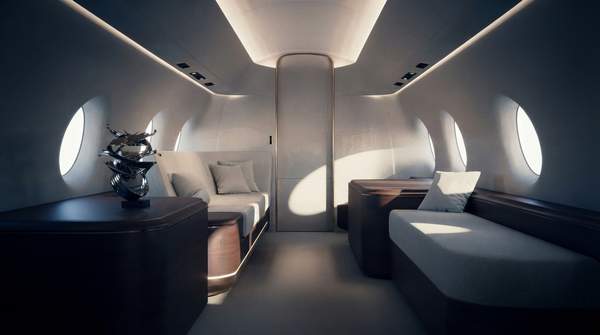
Cabin air in a modern private jet is not clean by accident. It is the product of a multi-stage environmental control system that pulls in outside air, strips out ozone, cools and conditions the supply, filters recirculated air through hospital-grade HEPA filters, and replaces the entire cabin volume every two to three minutes. Each stage solves a different air quality problem — ozone, temperature, particulates, and staleness — and together they create the fresh, comfortable environment passengers expect on a long-haul flight.
Introduction: The Quest for Pristine Cabin Air
The value of that system becomes obvious at altitude. Outside the aircraft, the air is far too thin and cold to breathe directly, so it must be conditioned before it ever reaches the cabin. Inside, a small enclosed space shared for hours makes air quality a comfort and health question, not a luxury afterthought.
According to broker Haute Jets, modern private jets use advanced circulation and filtration systems to maintain optimal air quality throughout a flight, with many charter aircraft fitted with High-Efficiency Particle Arrestance (HEPA) filters described as the gold standard in air purification. The Aviation Factory, a private aviation firm, reports that large-cabin, medium, and even certain light jets are often equipped with HEPA filters. What matters for the reader is not the individual components but the sequence: fresh and recirculated air take different paths through the system, and each path has its own treatment.
The Private Jet Cabin Air Treatment Cycle
The most useful mental model treats the cabin air system as a continuous loop with two entry points. Fresh air arrives as engine bleed air drawn from outside the aircraft; cabin air returns through recirculation vents near or below the seats. Both streams converge on the cabin supply, delivered through ceiling ducts.
Trace the full cycle as it is described by the manufacturer and industry sources below:
| Stage | Air Source | What Happens | Air Quality Outcome |
|---|---|---|---|
| 1. Bleed air intake | Outside air | Compressed air is drawn from the engines for cabin supply | Raw outside air, including atmospheric ozone |
| 2. Catalytic ozone converter | Outside air | Ozone is neutralized before further processing; converters also mitigate odorous kerosene vapors | Harmful ozone and ground-operation odors removed |
| 3. Air conditioning pack | Outside air | Air is cooled to the required temperature using ram air and air cycle machines | Temperature regulated for cabin comfort |
| 4. Cabin distribution | Treated fresh air | Clean, conditioned air is piped in through ceiling ducts | Fresh air delivered to passengers |
| 5. Recirculation and HEPA filtration | Cabin air | Returning air is mixed with fresh air and passed through HEPA filters | Particulates, viruses, and bacteria captured |
| 6. Extraction | Cabin air | Air is drawn out through vents beside or below the seats | Stale air removed; the cycle repeats every few minutes |
The Aviation Factory describes the balance once airborne: roughly 60 percent of the air is brought in from outside and 40 percent is filtered recirculated air, with the entire cabin volume swapped out every two to three minutes. Airbus, describing the architecture used on its own aircraft, notes that most ventilation systems provide a mix of fresh bleed air and recirculated airflow — a mix the FAA places at approximately 50 percent on large transport airplanes, varying with altitude and power settings.
HEPA Filtration: Hospital-Grade Air Purity
The HEPA filter is the workhorse of the recirculation path. It is not an aviation-specific invention — The Aviation Factory notes the technology is used widely and creates a "clean room" air exchange similar to a hospital operating theater.
Its performance is well quantified. NASA research, cited by The Aviation Factory, concluded that HEPA filters block or absorb 99.97 percent of airborne particles over 0.3 microns in size, including viruses and bacteria. The FAA confirms the same 99.97 percent figure for particulate removal on U.S. commercial airplanes using HEPA filters in the recirculated airflow. The practical consequence for passengers on a long flight is that the recirculated portion of cabin air is scrubbed of nearly all particulate contamination each time it passes through the loop.
One caution from the same source: this protection should not be taken for granted at all times — filter condition and maintenance matter, which is why routine checks are part of the system's reliability.
Rapid Air Exchange: Constant Freshness
Filtration alone would not prevent staleness in a sealed cabin. The second pillar is volume replacement. Haute Jets reports that a complete air exchange occurs every two to three minutes in a private jet cabin, a rate it describes as significantly more frequent than commercial airliners. The Aviation Factory gives the same two-to-three-minute figure for the full swap of cabin air.
That rate is what makes the system self-cleaning: contaminants have little time to accumulate because the air carrying them is continuously extracted and replaced. The constant inflow from ceiling ducts and outflow through floor-level vents also creates a steady downward circulation pattern, sweeping air away from passengers rather than letting it pool around them.
Catalytic Ozone Conversion: Neutralizing Atmospheric Ozone
The least visible stage may be the most chemically important. Aircraft cruise at altitudes where atmospheric ozone concentrations are far higher than at ground level, and ozone entering the cabin directly would irritate lungs and degrade air quality.
According to Airbus, long-haul aircraft — and even most short-haul aircraft — are equipped with catalytic ozone converters installed in the bleed air ducting upstream of the air conditioning pack. The placement is deliberate: the catalytic process needs sufficiently high temperatures to work, which the bleed air provides before cooling. Airbus notes that its modern converters, introduced in 2004, also mitigate odorous compounds from kerosene vapors encountered during ground operations, improving the cabin's smell as well as its safety. In other words, this stage cleans the incoming fresh air before it is ever cooled or distributed.
Integrated Climate Control: Temperature and Humidity Management
Air quality is only half the comfort equation; the other half is conditioning. Once ozone is removed, the bleed air enters the air conditioning pack, which Airbus describes as cooling the air to the required temperature using outside ram air as the cooling medium and air cycle machines for compression and expansion cooling. Airbus calls this basic architecture the best proven technology for aircraft air conditioning on efficiency, flexibility, reliability, installation space, and maintenance costs.
Temperature regulation works alongside pressurization. Haute Jets highlights the Gulfstream G650's enhanced pressurization system as an illustrative example: it maintains a lower cabin altitude, which the company says contributes to a more relaxing travel experience. In systems equipped with HEPA filtration, humidity in the range of 10–15 percent is presented by the evidence as a condition present in such cabins and a contributor to comfort on long-haul flights.
Ensuring Optimal Cabin Environment for Long-Haul Flights
The decision for private jet operators and passengers is straightforward: advanced multi-stage environmental control systems — ozone conversion, pack cooling, HEPA filtration, and rapid exchange — deliver superior cabin air quality, temperature, and humidity for health and comfort on long-haul flights. The measurable indicators are consistent passenger feedback on comfort and health, together with routine maintenance checks confirming that filters and ozone converters remain effective. For a reader evaluating a charter or an owned aircraft, the components to confirm by name are the HEPA filters, the catalytic ozone converter, the air exchange rate, and the maintenance schedule behind them.