For collectors weighing a six- or seven-figure acquisition, the decisive question is no longer whether to authenticate, but which technologies to deploy and in what combination. AI-based authentication, X-ray radiography, and infrared imaging answer fundamentally different questions: the first interrogates style and brushwork, the second physical structure and hidden alterations, the third underdrawings and surface changes. None is sufficient alone. The most reliable due diligence today layers all three alongside traditional connoisseurship—especially now that many artist foundations have stopped issuing authenticity opinions altogether.
AI-Based Authentication: Analyzing Patterns and Style
Machine-learning systems approach authenticity as a pattern-recognition problem. Rather than sampling paint or penetrating canvas, they compare a disputed work's visual characteristics—brushstroke patterns, handling of light, line, and composition—against thousands of authenticated references at once, a scale the company Art Recognition describes as "well beyond what any trained eye can carry in view." The firm, which builds its models with art historians, positions its analyses as documented, reproducible, and "explicit about its limits," offering an independent, data-driven contribution to a broader evidentiary file.
The approach has demonstrated real capability. A 2024 study by researchers applying Kolmogorov-Arnold and convolutional neural networks to forgery detection reported high accuracy in attributing works—including those by the convicted forger Wolfgang Beltracchi—while noting that the forger's handling of light, motion, and line of vision left detectable signatures in his brushwork. But the same study is candid about the constraint: accuracy is "strictly dependent upon the complexity of the dataset." AI sees only what its training data contains, and it cannot interrogate the physical object itself.
X-ray Radiography: Unveiling Hidden Layers and Structure
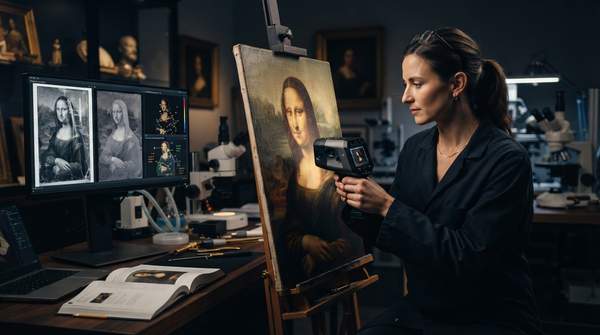
Where AI reads surfaces, X-ray radiography reads through them. The technique penetrates paint layers to reveal differences in material density, exposing concealed signatures, hidden sketches, overpainting, and earlier compositions beneath a painting's visible face. According to Hephaestus Analytical, it is particularly effective on paintings and sculptures, where examining internal structure allows experts to compare what lies beneath against historical records and catalogued information—verifying authenticity and detecting signs of tampering or restoration.
This is the technology's distinctive strength: it identifies changes made after the original creation. A painting that has been restored heavily, reworked, or painted over an earlier composition will confess that history to an X-ray plate regardless of how convincing its surface appears. Masterworks' research team similarly describes X-radiography as the imaging method that "sees through the paint to reveal hidden compositions and earlier sketches." Its limitation is the mirror of its power: it documents physical structure, not style, so it cannot by itself say whether a pristine, unaltered canvas was painted by the master or a skilled imitator.
Infrared Imaging: Revealing Underdrawings and Alterations
Infrared imaging occupies a complementary niche. This non-invasive technique captures the infrared spectrum of light to expose alterations and underdrawings—the preparatory sketches artists traditionally laid down before painting. Hephaestus Analytical notes that infrared reflectography and thermal imaging are the two common methods, and the technology has become one of the most widely used emerging tools in the field.
Its forensic value lies in process. Masterworks' researchers observe that infrared reflectography "exposes the underdrawing a forger often skips": a genuine period work typically carries preparatory construction consistent with the artist's documented practice, while a copy made from a finished image may lack it entirely. Infrared also reveals later interventions and, alongside ultraviolet fluorescence, can light up restoration campaigns invisible in normal light. Like X-radiography, however, it says nothing definitive about authorship on its own—an underdrawing's presence is evidence of process, not a signature.
Comparative Overview of Art Authentication Technologies
The table below contrasts the three technologies across consistent dimensions—analytical target, ideal application, key limitation, and role in due diligence—so a collector can match the tool to the question at hand. Use it to decide when a stylistic question calls for AI and when a material or structural question calls for imaging.
| Technology | What It Analyzes | Best Used For | Key Limitation | Role in Due Diligence |
|---|---|---|---|---|
| AI-Based Authentication | Stylistic elements, brushstroke patterns, and other visual characteristics, learned from databases of authenticated works | Comparing a work's style against thousands of references; providing an independent, objective view before buying, selling, or retaining art | Accuracy depends on the quality and breadth of training data; it is not a replacement for comprehensive analysis | A new layer of evidence that augments human expertise with scalable, reproducible analysis |
| X-ray Radiography | Internal structure and material densities beneath the paint layers | Detecting alterations, restorations, overpainting, and hidden compositions; comparing structure against historical records | Documents physical condition, not authorship—an unaltered work can still be a forgery | Establishes the physical history and integrity of the object; essential for detecting tampering |
| Infrared Imaging | Underdrawings, alterations, and later surface interventions, captured via reflectography or thermal imaging | Revealing preparatory sketches and modifications that a forger copying a finished image may omit | Evidence of process, not proof of authorship; findings require expert interpretation | Tests whether the work's construction matches documented studio practice |
The pattern that emerges is complementarity. AI answers "does this look like the artist's hand?" X-ray answers "has this object been physically altered?" Infrared answers "was this work built the way this artist worked?" A forgery that defeats one question often fails another.
The Multi-Layered Approach: Combining Technology with Connoisseurship
Why layering is now non-negotiable has as much to do with institutions as with technology. Masterworks' research team recounts that authentication boards dissolved under litigation pressure: owners rejected by the Warhol board sued, the board reported $7 million in legal fees, and its 2012 dissolution set a pattern followed by the Basquiat, Haring, and Lichtenstein bodies. The consequence for buyers is stark—due diligence has shifted onto the collector, and it costs real money and time.
Into that vacuum, AI firms position themselves as complements, not replacements. Carina Popovici of Art Recognition told Artnome that AI is "a helping tool to increase human connoisseurship," especially where experts disagree, refuse to opine, or no living expert exists. Hephaestus Analytical argues that the synergy between digital imaging, machine learning, and seasoned human expertise produces a more dependable process than any single method. Market acceptance, however, lags capability: reporting in ARTnews found the market still prefers academic research, the human eye, and technical analysis, and even AI's advocates concede the art world is far from adopting it as a standalone solution.
Building a Robust Authentication Strategy
Collectors should adopt a multi-layered approach to art authentication, combining AI analysis for stylistic patterns, scientific methods like X-ray and infrared imaging for material and structural insights, and traditional connoisseurship. The practical test of that strategy is measurable: a comprehensive authentication report that integrates findings from multiple technological and expert analyses, clearly addressing both stylistic and material aspects of the artwork. If a report answers only one of those questions—or rests on a single method's verdict—it is not due diligence; it is a bet.
Sources
- Art Recognition - Shaping tomorrow’s Art Authentication with AI
- Art Forgery Detection using Kolmogorov Arnold and Convolutional Neural Networks — ARXIV
- Art Authentication: Tradition versus Technology | — Hephaestusanalytical
- How Art Authentication Actually Works: Connoisseurship, Science, and Archives — Masterworks Academy
- Can AI Art Authentication Put An End To Art Forgery? — Artnome
- AI Is Trying to Take Over Art Authentication, but Longtime Experts Are Skeptical — ARTnews.com